
Nutrition facts
Calories in lasagna
The Sunday evening dish that gets cut into squares, and whose slice is better weighed than guessed: a real slice from a family dish beats the retail tray.
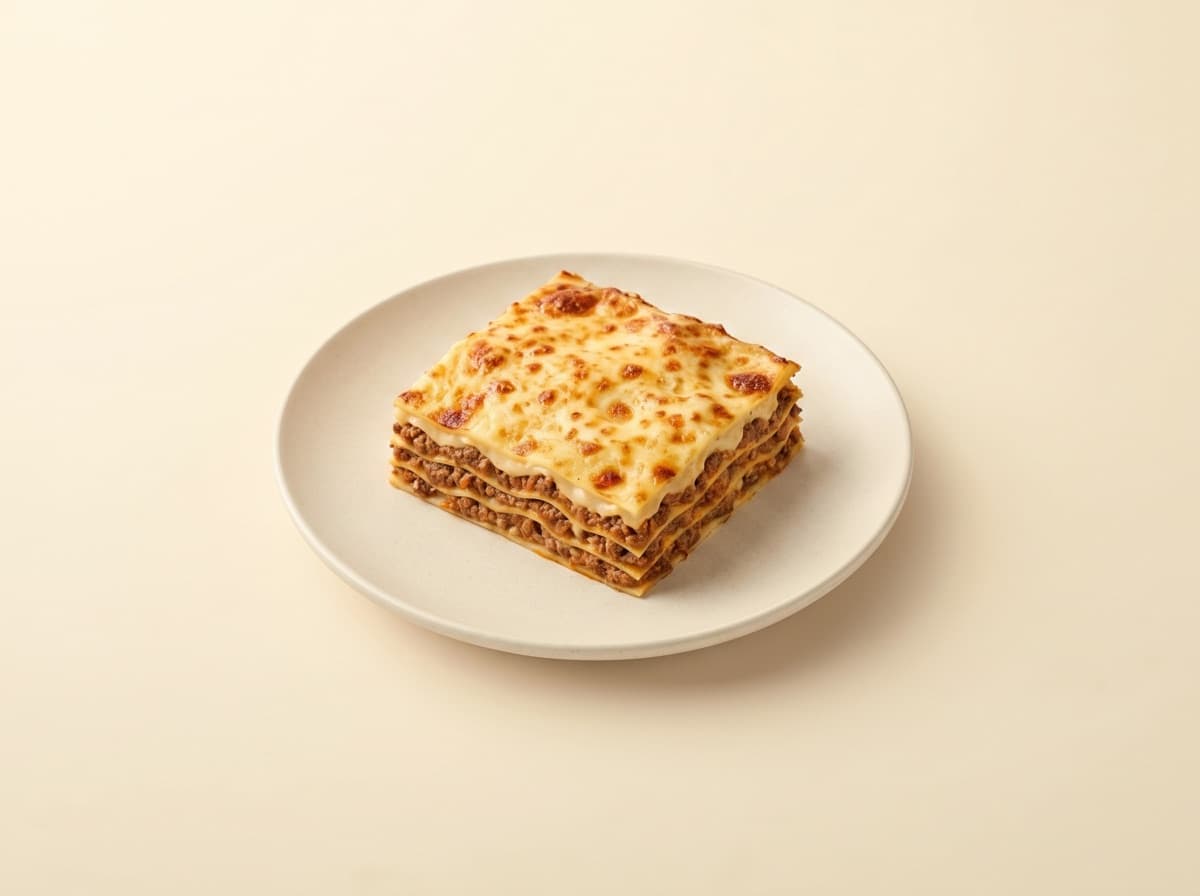
What a real portion weighs
The Anses table gives values per 100 grams, and 100 grams is not a portion anybody serves. Here are the same values, applied to the portions as they turn up. Weights are in grams, the unit the table is built on. For a quick conversion: 1 oz is about 28 g, and 1 lb is about 454 g.
| Portion | Weight | Energy | Protein | Carbs | Fat | Fiber |
|---|---|---|---|---|---|---|
| One slice | 300 g | 402 kcal | 18.9 g | 40.5 g | 17.2 g | 5.7 g |
| A small slice | 220 g | 295 kcal | 13.8 g | 29.7 g | 12.6 g | 4.2 g |
These weights are usual orders of magnitude, not standardized measures: they turn a per-100-gram value into a credible portion. A kitchen scale stays more accurate than any average weight.
Composition per 100 grams
Lasagna or cannelloni with meat (bolognese sauce), prepacked
- Energy
- 134 kcal
- Protein
- 6.3 g
- Carbohydrate
- 13.5 g
- of which sugars
- 2.8 g
- Fat
- 5.7 g
- Fiber
- 1.9 g
- Sodium
- 385 mg
What a table of values does not say
- A slice from a family dish almost always beats the portion of a retail tray: the three hundred grams of a real slice is a number to know, not to fear.
- Bechamel or cream, the build barely changes the table: it is the generosity of the cheese on top that separates one kitchen from another.
What comes after the number
How much to eat in a day
A portion means nothing without the day that holds it. A calorie need is worked out from height, weight, age and activity level, then split into protein, carbohydrate and fat.
Calorie calculatorWhere body build sits
Body mass index, the full WHO classification, and the weight range matching a normal build for a given height.
BMI calculatorAn average weight is an estimate. A photo is not.
In Zemiam, a photo of the meal is enough to log the real portion, with the composition of this same table rather than a guessed figure.
Where the values come from
The composition comes from the Anses Ciqual table: Anses. 2025. Table de composition nutritionnelle des aliments Ciqual, published under Licence Ouverte 2.0. The per-100 g values are reproduced without being altered; the per-portion values are those same values multiplied by a weight, and that weight is not an Anses figure.
The same page in French: Calories des lasagnes.