
Nutrition facts
Calories in a hard-boiled egg
The egg is one of the few foods whose unit weight is set by law in Europe. The size is printed on the box, and the arithmetic turns exact instead of approximate.
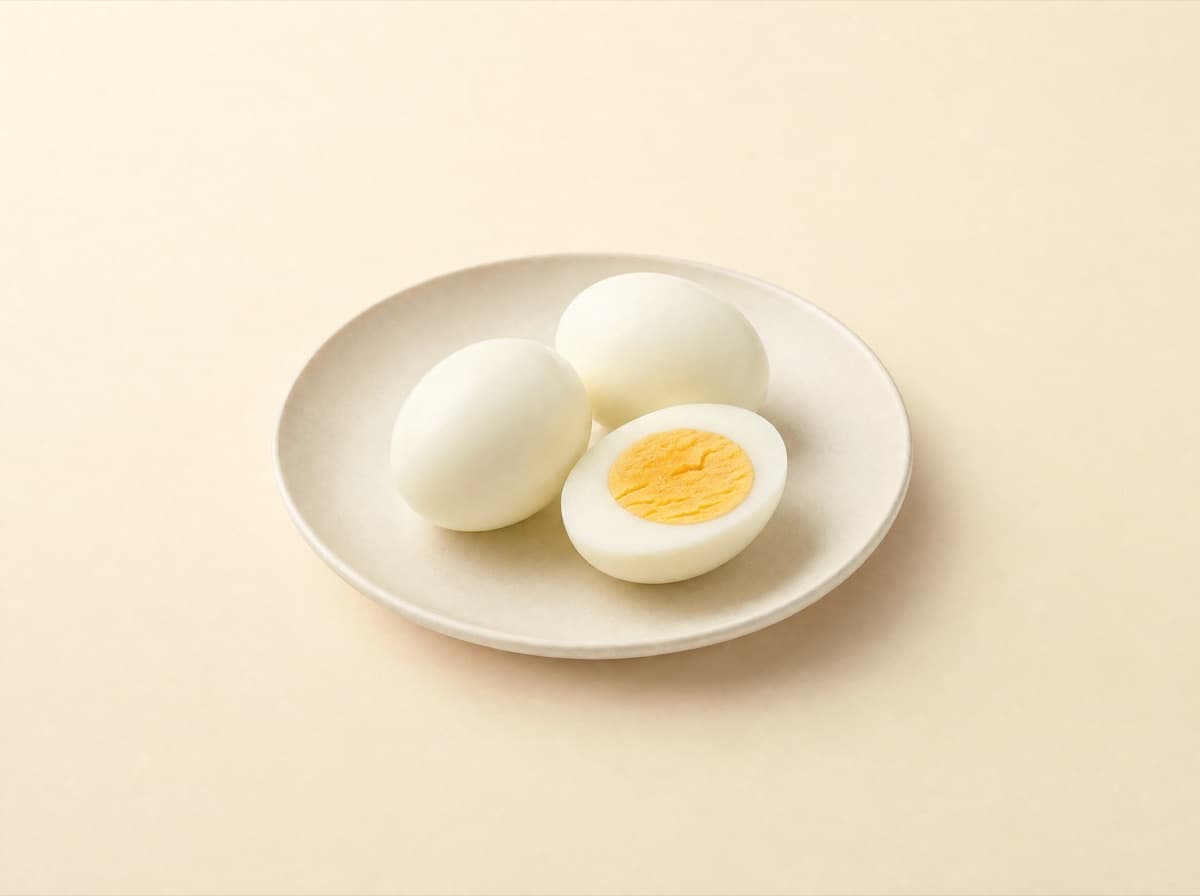
What a real portion weighs
The Anses table gives values per 100 grams, and 100 grams is not a portion anybody serves. Here are the same values, applied to the portions as they turn up. Weights are in grams, the unit the table is built on. For a quick conversion: 1 oz is about 28 g, and 1 lb is about 454 g.
| Portion | Weight | Energy | Protein | Carbs | Fat | Fiber |
|---|---|---|---|---|---|---|
| One medium egg, size M · shelled, hard-boiled | 52 g | 70 kcal | 7 g | 0.3 g | 4.5 g | 0 g |
| One small egg, size S · shelled | 44 g | 59 kcal | 5.9 g | 0.2 g | 3.8 g | 0 g |
| One large egg, size L · shelled | 60 g | 80 kcal | 8.1 g | 0.3 g | 5.2 g | 0 g |
| Two medium eggs · a meal-sized serving | 104 g | 139 kcal | 14 g | 0.5 g | 9 g | 0 g |
Where these weights come from. Sizes S, M, L and XL come from European regulation (EC) No 589/2008: S under 53 g, M from 53 to 63 g, L from 63 to 73 g, XL above, shell included. That is a European rule and not an American one. In the United States the USDA sizes eggs by the dozen instead: Large is 24 oz per dozen, about 57 g an egg in shell, which lands inside the European M band. The shell is roughly a tenth of the egg, and the weights above have taken it off, since Ciqual measures the edible part.
Composition per 100 grams
Egg, hard-boiled
- Energy
- 134 kcal
- Protein
- 13.5 g
- Carbohydrate
- 0.5 g
- of which sugars
- 0.5 g
- Fat
- 8.6 g
- Fiber
- 0 g
- Sodium
- 123 mg
What a table of values does not say
- The size printed on the box covers the whole egg, shell included. The weight that goes into a calorie calculation is what sits inside, about a tenth lighter.
- Hard-boiling changes neither the weight nor the composition: nothing is added, and nothing evaporates inside a closed shell. A fried egg carries the fat it was cooked in.
- Egg protein is the reference the others are measured against: its amino acid profile is the yardstick in protein quality tables.
The Zemiam recipes that use it
These pages carry their calories and their macros, recalculated from the same table as this one. The weight given is that of the ingredient in one serving.
- Hard-boiled egg with carrots and hummus · 100 g per serving
- Avocado toast with egg and cherry tomatoes · 50 g per serving
- Pan bagnat with tuna · 50 g per serving
- Potato salad with eggs and pickles · 100 g per serving
- Smoked salmon with hard-boiled eggs and arugula · 100 g per serving
What comes after the number
How much to eat in a day
A portion means nothing without the day that holds it. A calorie need is worked out from height, weight, age and activity level, then split into protein, carbohydrate and fat.
Calorie calculatorWhere body build sits
Body mass index, the full WHO classification, and the weight range matching a normal build for a given height.
BMI calculatorNeighboring pages
An average weight is an estimate. A photo is not.
In Zemiam, a photo of the meal is enough to log the real portion, with the composition of this same table rather than a guessed figure.
Where the values come from
The composition comes from the Anses Ciqual table: Anses. 2025. Table de composition nutritionnelle des aliments Ciqual, published under Licence Ouverte 2.0. The per-100 g values are reproduced without being altered; the per-portion values are those same values multiplied by a weight, and that weight is not an Anses figure.
The same page in French: Calories d'un œuf dur.