
Nutrition facts
Chicken breast: protein and calories
Chicken breast is the protein reference of this whole set, and the only food here where cooking concentrates instead of diluting.
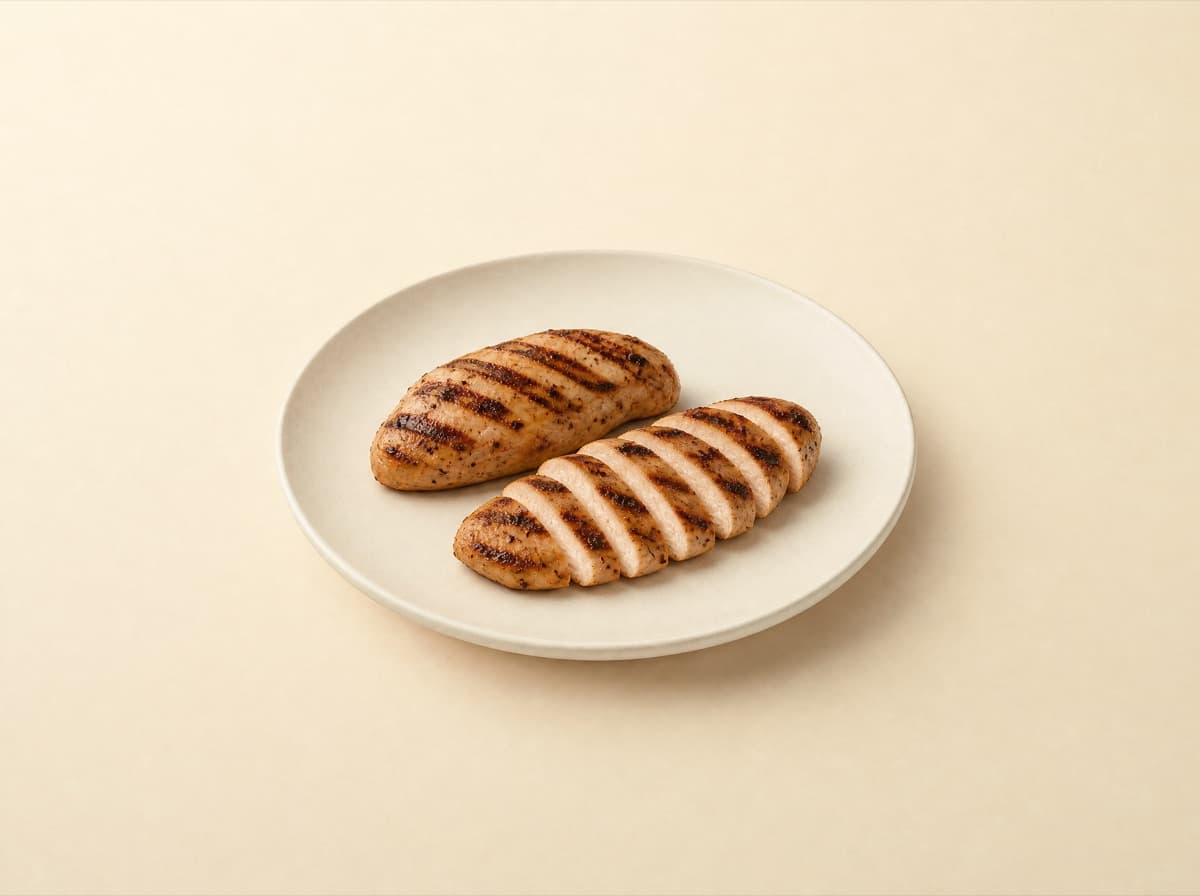
What a real portion weighs
The Anses table gives values per 100 grams, and 100 grams is not a portion anybody serves. Here are the same values, applied to the portions as they turn up. Weights are in grams, the unit the table is built on. For a quick conversion: 1 oz is about 28 g, and 1 lb is about 454 g.
| Portion | Weight | Energy | Protein | Carbs | Fat | Fiber |
|---|---|---|---|---|---|---|
| One cooked breast · about 150 g raw | 120 g | 169 kcal | 36.1 g | 0 g | 2.4 g | 0 g |
| A meal-sized serving · cooked, skinless | 150 g | 212 kcal | 45.2 g | 0 g | 3 g | 0 g |
| A small serving · cooked, skinless | 100 g | 141 kcal | 30.1 g | 0 g | 2 g | 0 g |
| The Ciqual reference · skinless fillet, grilled or pan-fried | 100 g | 141 kcal | 30.1 g | 0 g | 2 g | 0 g |
These weights are usual orders of magnitude, not standardized measures: they turn a per-100-gram value into a credible portion. A kitchen scale stays more accurate than any average weight.
Composition per 100 grams
Chicken, breast, without skin, grilled/pan-fried
- Energy
- 141 kcal
- Protein
- 30.1 g
- Carbohydrate
- 0 g
- of which sugars
- 0 g
- Fat
- 2 g
- Fiber
- 0 g
- Sodium
- 56 mg
Chicken breast vs raw chicken breast
The same fillet, raw and then cooked. The gap is water gone, not anything added.
| Food | Energy | Protein | Carbs | Fat | Fiber |
|---|---|---|---|---|---|
| Chicken breast | 141 kcal | 30.1 g | 0 g | 2 g | 0 g |
| Raw chicken breast | 110 kcal | 23.4 g | 0 g | 1.5 g | 0 g |
Weight for weight, the chicken breast: 28% more energy.
What a table of values does not say
- Meat loses water as it cooks, so it concentrates. That is the opposite of rice and pasta, and it is why 100 g of cooked chicken carries more protein than 100 g of raw.
- A 150 g raw fillet comes back around 120 g once cooked. Weighing after the pan skips the arithmetic, but it means reading the cooked line rather than the raw one.
- The skin changes everything: it carries most of the fat on the cut, and the table gives it lines of its own.
The Zemiam recipes that use it
These pages carry their calories and their macros, recalculated from the same table as this one. The weight given is that of the ingredient in one serving.
- Grilled chicken with rice and greens · 130 g per serving
- Chicken salad with avocado and cherry tomatoes · 100 g per serving
- Homemade chicken kebab with white sauce · 130 g per serving
- Chicken wrap with fresh vegetables · 100 g per serving
- Quinoa salad with chicken, cucumber and feta · 100 g per serving
- Pasta with pesto and chicken · 80 g per serving
- Chicken breast with green lentils and broccoli · 150 g per serving
- Chicken breast with polenta and zucchini · 130 g per serving
What comes after the number
How much to eat in a day
A portion means nothing without the day that holds it. A calorie need is worked out from height, weight, age and activity level, then split into protein, carbohydrate and fat.
Calorie calculatorWhere body build sits
Body mass index, the full WHO classification, and the weight range matching a normal build for a given height.
BMI calculatorNeighboring pages
An average weight is an estimate. A photo is not.
In Zemiam, a photo of the meal is enough to log the real portion, with the composition of this same table rather than a guessed figure.
Where the values come from
The composition comes from the Anses Ciqual table: Anses. 2025. Table de composition nutritionnelle des aliments Ciqual, published under Licence Ouverte 2.0. The per-100 g values are reproduced without being altered; the per-portion values are those same values multiplied by a weight, and that weight is not an Anses figure.
The same page in French: Protéines et calories du blanc de poulet.